






|
Lake
McConaughy
As
early as the 1880's, citizens of south-central Nebraska
discussed the possibility of bringing irrigation to the area.
Interest in irrigation grew with each successive drought cycle
until the drought and economic depression of the 1930's helped
convince state and federal officials and community leaders of
the need for irrigation.
The Public
Works Administration approved funding for the hydro-irrigation
project in 1935 and construction began in 1936. Kingsley
Dam was closed and dedicated in 1941 and project operations
began soon afterward.
The dam and
reservoir are named for George P. Kingsley, a Minden, Nebraska
banker, and C.W. McConaughy, a grain merchant and mayor of
Holdrege, Nebraska, two of the leading promoters of the project.
Although neither lived to see the completion of the project,
their leadership and perseverance eventually culminated in a
public power and irrigation project that helped Nebraska become
one of the nation's leading agricultural states.
History of Kingsley Dam
|
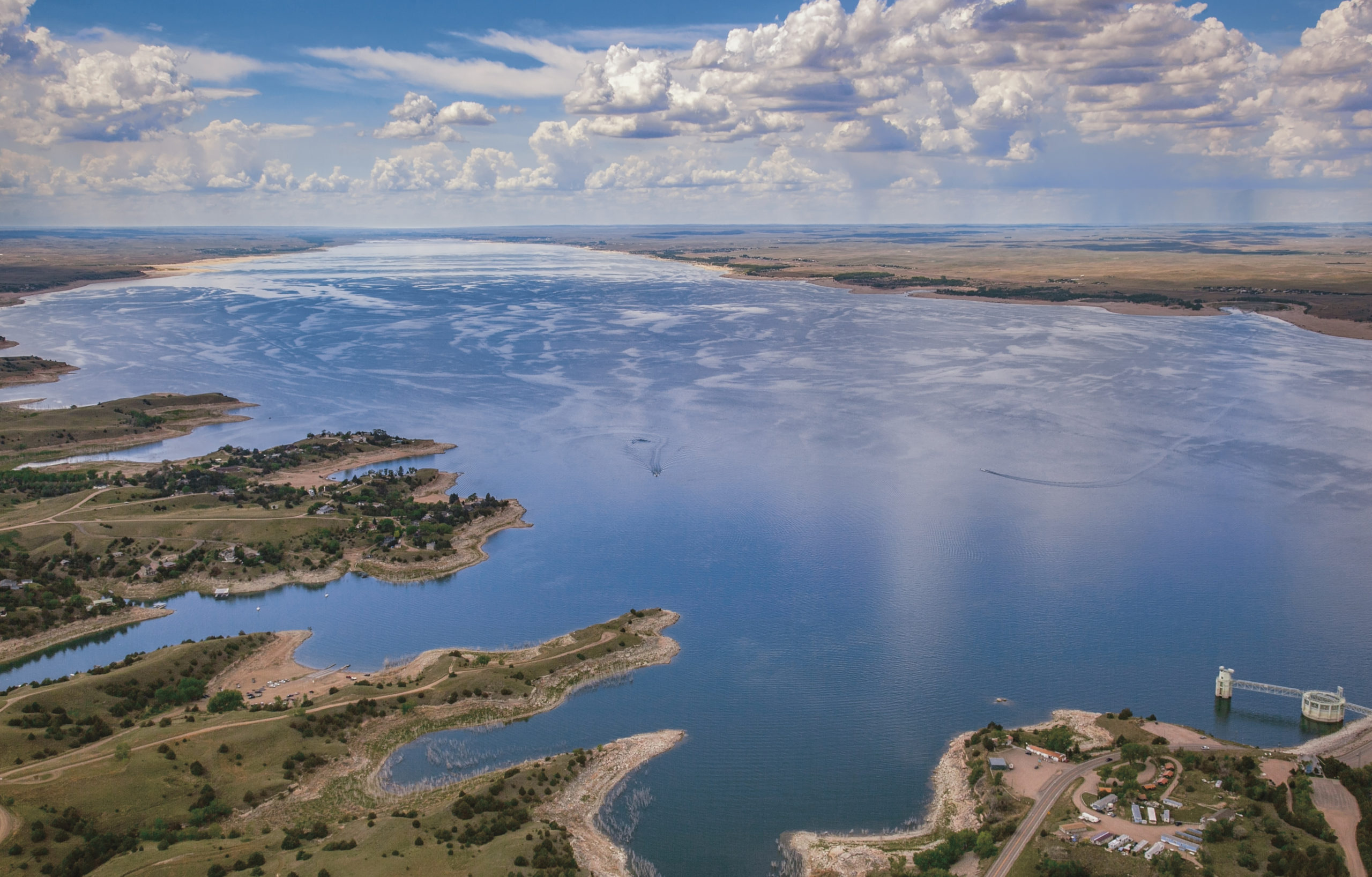
The Kingsley Dam, located 9 miles north of Ogallala, Nebraska,
is the second largest, hydraulic fill dam in the world. It is
over 162 feet high, 3.1 miles long, has 26 million cubic yards
of material, and holds a body of water that is 22 miles long and
142 feet deep called Lake McConaughy.
The
Kingsley Dam was formed by the pumping of a mixture of
loess soil and water into the ground, making a
watertight core. Lake Ogallala was formed from the
pumping of the soil into Kingsley Dam. It is 35
feet deep, 1.6 miles long, and .3 miles wide.
|
 |
|
 |
Even
though it is smaller than Lake McConaughy, it’s in the
middle class size of lakes in Nebraska. Sand from the riverbed below
was pumped to form the sides of the dam. Then, to make sure
that nothing would try to go under the dam, giant steel sheets
were driven into the watertight core and into the ground below.
The water facing side of the dam is layered with limestone rocks
from Wyoming and 180,000 “jackstones.” |
A jackstone
is a 6-pointed stone that looks similar to a toy jack, weighing
over 800 pounds each, for a combined weight of 144 million
pounds. It is said, that if the dam collapses, the city of North
Platte, located 50 miles to the east, has 45 minutes to evacuate
before their city is destroyed.
A unique
feature to the Kingsley Dam is the water release and flood
control system. The system is located on the south side of the
dam, partially in the water and is composed of two parts, the
outlet tower and the morning glory spillway. The outlet tower
is 185 feet tall, 42 feet wide, has one ring gate and 4 tractor
gates that regulate normal water release functions like
irrigation. The gates are located on the sides and middle of
the structure. The structure is connected to a 20 foot wide,
steel reinforced, concrete tube that runs underground to the
power plant on the other side of the dam. When all the gates
are open, it can release over 7,000 cubic feet per second, or
over 420 thousand gallons a minute.
The Morning
Glory spillway is named for the way it’s shaped. It looks like
a morning glory flower if you’re looking down into it. It is
used only in emergencies when water levels are too high. The
Morning Glory has 12 gates that are 16 feet high, 22 feet wide,
3 feet thick, and can discharge 54,000 cubic feet per second, or
3,240,000 gallons a minute. This water is released through an
opening on the opposite side of the dam. |